
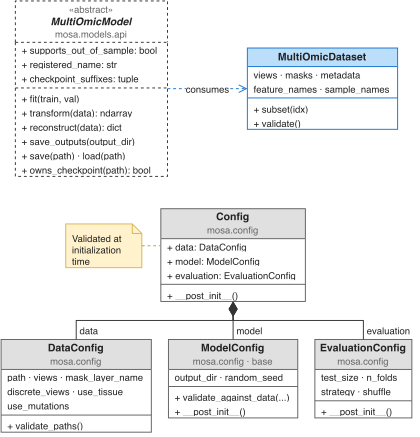
MultiOmicModel defines the adapter methods. The CLI and evaluator also require the input, prediction, and persistence conventions below; batching and training remain implementation-specific.
Input data
Models receive a MultiOmicDataset, with one shared sample axis:
| Field | Meaning |
|---|---|
views[name] |
Float32 matrix with shape (N, P_name). Missing values may be NaN. |
masks[name] |
Boolean matrix of the same shape; True means observed. |
metadata |
DataFrame indexed by sample ID, in the matrices' row order. model_type is required; tissue and mutations are optional. |
feature_names[name] |
Feature identifiers in the matrix's column order. |
Call data.validate() to check structural consistency. subset(indices) selects samples while retaining feature order. A view can be absent for individual samples even though its key and matrix remain present. Use the masks to decide what is observed; do not turn missing entries into measured zeros.
Each adapter fits its preprocessing, categorical encodings, and missing-value treatment on training samples only, then persists and reuses them for validation and projection. The shared loader does not fit scalers.
Construction and fitting
build_model(data_cfg, model_cfg) calls the registered class with those two arguments. Store both configurations. fit(train, val=None, resume_from=None) must accept the interface's named arguments even when validation or resumption is unsupported; explain that behaviour and report it clearly to callers.
The CLI calls fit() then save_outputs(). Cross-validation calls fit(train, val) then reconstruct(val) directly, without calling save_outputs(). An adapter supporting cross-validation must therefore be able to predict immediately after fitting, even if it materializes a temporary backend artifact internally. The MOFA adapter uses this approach.
Validation data may influence early stopping, but must not be incorporated into training-derived preprocessing. Create a fresh model state for each fit and respect the supplied output directory; cross-validation replaces it with a temporary directory.
Prediction
transform(data) returns a NumPy array of shape (N, latent_dim). reconstruct(data) returns a dictionary with arrays of shape (N, P_view). Rows must match the supplied sample order, and reconstruction columns must match each view's feature order. Reconstruction scores compare these arrays directly to the input.
Reverse fitted preprocessing before returning reconstructions: scoring assumes the input scale and feature order. Reject incompatible features, categories, or likelihoods explicitly; shape checks alone cannot detect incorrect order or scale.
Cross-validation expects reconstructions for every configured view, including predictions for missing entries. Its score uses only observed entries. If the method cannot reconstruct a supported view on the input scale, reject that operation rather than silently omitting it.
Set supports_out_of_sample = False for transductive methods that cannot reconstruct held-out samples; the default is True. Cross-validation and optimization check this flag before fitting, but adapters must still validate features, categories, and likelihoods.
Persistence
save(path) and classmethod load(path, **kwargs) own the saved-model format. Save the fitted parameters and every dependency of prediction: preprocessing statistics, source/category mappings, feature order, and data/model configuration where relevant.
After loading, the CLI needs data_cfg.views and data_cfg.mask_layer_name. transform() and reconstruct() must work without the original training configuration file. Preserve the meaning of the model's coordinates across the round trip.
Checkpoint ownership
The registry asks each model class owns_checkpoint(path) and loads only when exactly one class claims the file. The default implementation checks checkpoint_suffixes. Call require_checkpoint_suffix(path) from save() to catch a filename that dispatch cannot route back to the class.
Prefer a unique suffix. For shared suffixes, owns_checkpoint() must inspect an identifier or file structure, returning False for unrecognized or unreadable files. Keep the check inexpensive and independent of training data, as in the VAE and MOFA adapters.
Exported results and history
save_outputs(output_dir=None) is responsible for creating directories and writing exports. None means the configured model_cfg.output_dir. To use the library's training-result plots, write full/latent.parquet (or the supported train/ fallback) indexed by sample ID and recon_<view>.parquet with feature columns. See Saved outputs.
Document which samples full/ contains and which views support export. Model files and additional split directories are implementation-specific.
epoch_history is a list of dictionaries with epoch and available train_loss / val_loss values. Initialize it on each instance to avoid sharing the base class's mutable default. Non-epoch methods can leave it empty. Cross-validation collects this history for its CSV output. The current training-result loss plots read Lightning CSV files; an arbitrary history list does not automatically provide those plots.
Configuration and search
A configuration class must be a ModelConfig dataclass subclass. The registry pairs its exact type with one model class and uses the registered name for YAML selection. Nested configuration requires explicit parsing through from_yaml_dict().
Optimization uses dataclasses.replace() to sample top-level model fields, constructing a fresh configuration per trial. Its __post_init__() must reject invalid combinations. Evaluation settings and nested per-view fields are outside the search space. Failed configurations or fits are pruned, but a capability or input restriction should be documented before users start a study.
Verification
Use small datasets with partial masks, a fully missing view for some samples, distinct feature names, and shuffled sample order. Verify:
- Predicted shapes, row order, and feature order match the supplied dataset.
- Preprocessing is learned from training values only, reused after loading, and reversed in reconstructions.
- New samples either project successfully or are rejected according to the documented capability.
- Unknown categories, changed feature order, and unsupported likelihoods fail clearly.
- Predictions agree before and after save/load, within the method's numeric tolerance.
- Exported Parquets retain sample IDs and feature names, and an explicit output override is respected.
reconstruct(val)works immediately afterfit(train, val)when held-out evaluation is supported.- Cross-validation and optimization work through the registry rather than calling the class directly.
Registry tests check registered implementations against the interface and drive a dummy external method through the shared workflow. API tests exercise the current model lifecycles. Add meaningful tests for your method's behaviour and run the repository checks.